StatCounter
29/11/2010
fox in the snow
Here’s a little pick me up for the cold wintry weather. Fox were a British rock band that had some brief commercial success in the mid-70s, but so far as I can see are now known or remembered for very little.
This track ‘Yuli Yuli’ is off ‘Tails of Illusion’, released in 1975.

23/11/2010
apple vs apples vs apple vs apple ends!
There doesn’t really need to be an excuse to talk about The Beatles but it’s worth having one anyway. With the full catalogue licensed for itunes and John Lennon’s solo material on Spotify for the first time ever, this can truly be said to be the week that the band went digital. The most coveted discography worldwide was the subject of over seven years of litigation until last Tuesday, when it finally drifted down the 320kbps river and into the expansive online sea, never to be seen again.
The periodic media, fan and industry probing which somehow went on for years- and led even the ever-indifferent Ringo Starr to suggest that he gave a little more than a shit about something; anything, (“particularly glad to no longer be asked” apparently) for once wasn’t asking anything, and out came the press release.
The Beatles sold 450,000 albums and 2 million individual songs in the first week, although perhaps more impressively, all 17 albums, which were released at once made the top 100 albums on itunes.
21/11/2010
root of it all
The turbulent political climate in the US today reminds citizens of the battles fought over the Vietnam War, civil rights and social norms in the late 1960s. It was and remains a rich cultural stomping ground. When the divide between left and right hardens beyond a certain point, many artists still choose to up politics; they remember the way in which fundamentals of musical evolution in the 20th century were linked to politics- poverty, anti-war, black struggle- and they have various and vivid reference points from which to begin: “Bill Withers recorded this song at the end of the Vietnam War. As I record this now, America- the land of peace and prosperity is in the middle of two wars.” After Bill spoke to a young man who had served, he wrote ‘I Can’t Write Left-Handed’. Social consciousness is the central tenet in this part-heated, part-laid back collaboration between The Roots and John Legend, and yet, what seems so unusual about it, is how despite the above quote, it is pretty much isolated as an activist record by a high profile artist or artists. I mean really; you have to be daft not to figure out that this is a concept album- a clear, unambiguous plea for anti-war and liberal politics. “War is hell. It always has been and always will be.” 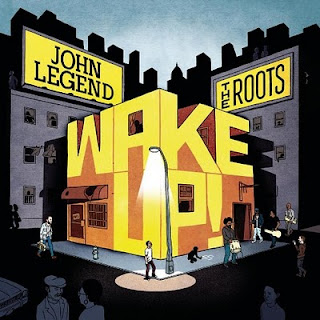 ‘What this music is about- indeed why it was made, is so important to bear in mind. ‘Wake Up!’ is about America today; informed by it, holding up a mirror to it and making bold statements about it, with protest songs. It is something so alien to the chart today as political musicians- at most- aren’t putting their thoughts into their music, if considering it part of their modus at all. For The Roots and Legend then, big-selling commercial artists, the need for this to be a record that fans can take into their hearts just as much as any other, and enjoy- simply- ‘for the music’ is a naturally restraining force on the activist statements. It makes the idea of ‘Wake Up!’, which evokes the extreme, urgent militancy of The Last Poets’ seminal ‘This is Madness’, an uncomfortable, somewhat cringe-worthy proposition in principle and often on listening.
Legend’s six-grammy award winning, philanthropic juggernaut of soul man is a natural partner musically for a band whose focus is the soulful, instrument-led end of hip-hop. We arrive on ‘Hard Times’; a quite self-explanatory suggestion of the themes and general messages to come. But it is not, in any way, an expression of how you will feel about the music. Legend’s silky tones are first exemplified by Questlove’s excellent signature hollowed out percussion, and then by Black Thought, who raps on alternate verses. It’s a blend of direct, sobering vocals and Legend’s typically reassuring tones, but from the very beginning, the soul and hip-hop directions self-evidently complement one another.
When you listen to ‘Wake Up!’, the oozing swagger of ‘Wake Up Everybody!’ is hard to miss. Melanie Fiona delivers a refreshing zing on guest vocals, emanating the clarity, harmony and sunny optimism of the song’s uplifting message (established by Harold Melvin & The Bluenotes more than 30 years ago): “Wake up all the teachers, time to teach a new way. Maybe then they’ll listen to what you have to say.” The block by block repetition of the structure, with doctors, builders and everybody(!) builds a disarmingly anthemic message. I recommend listening to both versions for an interesting comparison on how this bad boy looked in 1975.
The Roots draw inspiration from the various strands of black culture that have entwined with messages of social consciousness over the past 50 years, some radical, and some moderate, like the gospel references on ‘I Wish I Knew How It Would Feel To Be Free’. ‘Humanity’s reggae vibe, for example, sits quite uncomfortably alongside Legend’s unmistakably jazz-lounge style- an example of one of those instances where pushing a tempered, accessible sound as well as an honest replication of a genre’s political essence hasn’t really worked. Generally-speaking however, smooth intonements and production do successfully elevate the messages, rather than obstructing them. The 11-minute march ‘I Can’t Write Left-Handed’ and ‘Our Generation (Hope of the World)’ also show that loosely hung together, spontaneous outbursts of feeling are never outshone by more comfortable, softer numbers (‘Shine’ and ‘Holy’).
‘Wake Up!’ is an exciting, rich and diverse accomplishment that has clearly been produced with much thought and evaluation. Not only are The Roots and John Legend pillars of modern music today in their own rights, but the coming together of the former’s driving brass and lyrics, and the latter’s unmatched urban sophistication make this an album of different shades and dimensions, painting mellow, pretty and insular pictures at times, and at others outward, angry and revolutionary ones. Across the spectrum, this is a tale of political feeling and thought. Yet, perhaps, what rings out truest is that there was a time when every artist seemed to have something to say. From Bill Withers to Nina Simone, this album does its rich cultural ancestry proud.
John Legend & The Roots- I Can't Write Left-Handed
John Legend & The Roots- Wake Up Everybody
John Legend & The Roots- I Wish I Knew How It Would Feel To Be Free
 ‘What this music is about- indeed why it was made, is so important to bear in mind. ‘Wake Up!’ is about America today; informed by it, holding up a mirror to it and making bold statements about it, with protest songs. It is something so alien to the chart today as political musicians- at most- aren’t putting their thoughts into their music, if considering it part of their modus at all. For The Roots and Legend then, big-selling commercial artists, the need for this to be a record that fans can take into their hearts just as much as any other, and enjoy- simply- ‘for the music’ is a naturally restraining force on the activist statements. It makes the idea of ‘Wake Up!’, which evokes the extreme, urgent militancy of The Last Poets’ seminal ‘This is Madness’, an uncomfortable, somewhat cringe-worthy proposition in principle and often on listening.
Legend’s six-grammy award winning, philanthropic juggernaut of soul man is a natural partner musically for a band whose focus is the soulful, instrument-led end of hip-hop. We arrive on ‘Hard Times’; a quite self-explanatory suggestion of the themes and general messages to come. But it is not, in any way, an expression of how you will feel about the music. Legend’s silky tones are first exemplified by Questlove’s excellent signature hollowed out percussion, and then by Black Thought, who raps on alternate verses. It’s a blend of direct, sobering vocals and Legend’s typically reassuring tones, but from the very beginning, the soul and hip-hop directions self-evidently complement one another.
When you listen to ‘Wake Up!’, the oozing swagger of ‘Wake Up Everybody!’ is hard to miss. Melanie Fiona delivers a refreshing zing on guest vocals, emanating the clarity, harmony and sunny optimism of the song’s uplifting message (established by Harold Melvin & The Bluenotes more than 30 years ago): “Wake up all the teachers, time to teach a new way. Maybe then they’ll listen to what you have to say.” The block by block repetition of the structure, with doctors, builders and everybody(!) builds a disarmingly anthemic message. I recommend listening to both versions for an interesting comparison on how this bad boy looked in 1975.
The Roots draw inspiration from the various strands of black culture that have entwined with messages of social consciousness over the past 50 years, some radical, and some moderate, like the gospel references on ‘I Wish I Knew How It Would Feel To Be Free’. ‘Humanity’s reggae vibe, for example, sits quite uncomfortably alongside Legend’s unmistakably jazz-lounge style- an example of one of those instances where pushing a tempered, accessible sound as well as an honest replication of a genre’s political essence hasn’t really worked. Generally-speaking however, smooth intonements and production do successfully elevate the messages, rather than obstructing them. The 11-minute march ‘I Can’t Write Left-Handed’ and ‘Our Generation (Hope of the World)’ also show that loosely hung together, spontaneous outbursts of feeling are never outshone by more comfortable, softer numbers (‘Shine’ and ‘Holy’).
‘Wake Up!’ is an exciting, rich and diverse accomplishment that has clearly been produced with much thought and evaluation. Not only are The Roots and John Legend pillars of modern music today in their own rights, but the coming together of the former’s driving brass and lyrics, and the latter’s unmatched urban sophistication make this an album of different shades and dimensions, painting mellow, pretty and insular pictures at times, and at others outward, angry and revolutionary ones. Across the spectrum, this is a tale of political feeling and thought. Yet, perhaps, what rings out truest is that there was a time when every artist seemed to have something to say. From Bill Withers to Nina Simone, this album does its rich cultural ancestry proud.
John Legend & The Roots- I Can't Write Left-Handed
John Legend & The Roots- Wake Up Everybody
John Legend & The Roots- I Wish I Knew How It Would Feel To Be Free
13/11/2010
Glasser- Ring (a guest review!)
Mix one part tribal drums, one part electronica and two parts epic harmonies and leave in the fridge overnight...
You awake the next morning to a cacophony of heavenly vocals emanating from the kitchen.
You wander down the stairs, hearing the beat of tribal drums getting louder and louder as you approach and open the fridge door:
This is “Ring”, the debut album from Glasser.
If we were to think of music as a spectrum of colour, with Fever Ray on the dark side, Cameron Mesirow’s Glasser would surely be at the opposite end. Her music resembles Fever Ray with similarly echoing female vocals, but lighter and more accessible in nature as compared to the somewhat scary sound of her Swedish contemporary.

Opening track “Apply” introduces the tribal beat that sets the tone and continues to be the strongest element of the song, almost overpowering Mesirow’s vocals; that is until the harmonious “morning” takes over and continues to build with additional layered vocals.
“Home” is my personal favourite from the album, and blends so many layers together it’s difficult to keep up; you’re just along for the ride as Mesirow’s harmonies reach an uplifting, almost stadium-filling sound.
Glasser- Home
The pentatonic scale used in “Glad” starts to unwind an oriental sound, and, if you listen closely to the strings and bells towards the end of “Home” (the previous track), you can almost hear its seed being planted.
“Plain Temp” takes us back to the tribal theme and is almost reminiscent of the “Circle of Life” from Disney’s “The Lion King” in its repeating chorus.
In terms of beat and vocals, “T” is closer to Fever Ray. Yet it never really gets going, even with the introduction of the synthesiser halfway through the track. At a little over 5 minutes long, it left me rather disappointed. Still, the opening line of “Tremel” (recently remixed by Jamie from The XX) always reminds me of the vocal melody of The Beatles “Eleanor Rigby”, which can only be a good thing. It only repeats a couple of times, but I like to think it was perhaps a little nod to one of Mesirow’s musical heroes.
Seventh of nine is “Mirrorage”. This starts off with a humming minimal beat, but Mesirow keeps layering and layering, building this into another standout from the album- even surprising along the way with some interesting vocals near the end that I’ll leave for you as a surprise.
Glasser- Mirrorage
Penultimate song “Treasure of We” returns to the pentatonic scale but only really picks up half way through. Like many of the songs on this album, it travels and evolves, and, by its climax, has amassed the same expansive reverberations as Florence and the Machine.
Finishing the album: “Clamour”. Mesirow blends everything we’ve heard so far into one, even adding a brass instrument we haven’t yet experienced.
So, when everything is done, there are simply echoes of the past. Somewhere, faintly in the background, the drumming comes back, looping us back to the beginning of “Apply”.
And, suddenly, you’re back standing in your kitchen, staring into the fridge, wondering what just happened.
This really is one of my standout albums of 2010 and I hope you enjoy it.
Now go get a bongo and “Apply” twice a day.
25/10/2010
JAMES BLAKE
Rampaging across the blogosphere, James Blake’s music has traversed and codified many of the common influences appearing among breaking artists in the past six months. The London-based electronic producer, still only 21, is on his fourth EP. Here, I will be focusing on his third: CMYK.
You will see below ‘How to Dress Well’ and how Tom Krell’s bedroom-created dreams were inspired by 90s R&B. Well, CMYK is a rather different outcome from the same inputs. Aaliyah and Kelis samples are dropped in, worked upon and fished out of an electronic hubbub- as before HTDW, I could not have imagined. The genre focused upon is emotional, hazy and subtly tinged with memory: “a kind of dead zone for nostalgia, not yet retro-ready but no longer current”, says Mike Powell on Pitchfork. And I would certainly agree. Fleeting use of these 90s tracks do strike a dead zone, in which early twenty somethings- such as myself- have snippets of these commercial tracks from childhood lodged somewhere in the back of minds. Vague, and not fully formed.
The stop-start of ‘Footnotes’ drifts into an addictive half-beat reminiscent of the best warped dubstep. It rarely gets more than minimal, but never less than the synthesiser and clapping beat that together mark this out as a conspiratorial and jittery five minutes. The song with which most readers might be most familiar is 'CMYK'. Its upbeat and frequently joyous lifts are a good example of the smooth R&B Blake gently handles. ‘I’ll Stay’ is warmer, and I would love to know where he found the short, one second thuds that roll around it.
Overall, the EP is, in my view one of the best and most exciting of the year. In just four tracks, it could scarcely manage more wild journeying, both through time and exploring the subject of memory, with so few and carefully chosen blips, beats and jolts. Thoroughly recommended to any open minded listener...particularly in you enjoy How to Dress Well!
James Blake- CMYK
James Blake- Footnotes
You will see below ‘How to Dress Well’ and how Tom Krell’s bedroom-created dreams were inspired by 90s R&B. Well, CMYK is a rather different outcome from the same inputs. Aaliyah and Kelis samples are dropped in, worked upon and fished out of an electronic hubbub- as before HTDW, I could not have imagined. The genre focused upon is emotional, hazy and subtly tinged with memory: “a kind of dead zone for nostalgia, not yet retro-ready but no longer current”, says Mike Powell on Pitchfork. And I would certainly agree. Fleeting use of these 90s tracks do strike a dead zone, in which early twenty somethings- such as myself- have snippets of these commercial tracks from childhood lodged somewhere in the back of minds. Vague, and not fully formed.

The stop-start of ‘Footnotes’ drifts into an addictive half-beat reminiscent of the best warped dubstep. It rarely gets more than minimal, but never less than the synthesiser and clapping beat that together mark this out as a conspiratorial and jittery five minutes. The song with which most readers might be most familiar is 'CMYK'. Its upbeat and frequently joyous lifts are a good example of the smooth R&B Blake gently handles. ‘I’ll Stay’ is warmer, and I would love to know where he found the short, one second thuds that roll around it.
Overall, the EP is, in my view one of the best and most exciting of the year. In just four tracks, it could scarcely manage more wild journeying, both through time and exploring the subject of memory, with so few and carefully chosen blips, beats and jolts. Thoroughly recommended to any open minded listener...particularly in you enjoy How to Dress Well!
James Blake- CMYK
James Blake- Footnotes
06/10/2010
FRESH DENIM

White Denim kindly released this new EP Last Day of Summer for free through their WEBSITE last week. It's a rough outline of their work on a third album. 'Shy Billy' will hopefully really kick out after the 2mins-ish available now, when (or if) it's selected for the album.
White Denim- Shy Billy
02/10/2010
RUMER
I was fortunate enough to run into Later…With Jools Holland last Friday night, because this excellent blues singer was on called Rumer. John Prescott of all people also saw it apparently, and posted as much on twitter to show his generous support (appreciation that is, not a belt.) Rumer's performance really was a stand out for the series: confident, elegant and most of all touching compositions. In her voice, an unassuming melancholy and gentleness eminates, like the great Carole King. The album ‘Seasons of My Soul’ is out 1st November.
Rumer by Rumer
Rumer by Rumer
29/09/2010
“THE BIGGEST BREAKTHROUGH IN HOME RECORDED LO-FI IN YEARS.”
Not exactly sure how great a statement that is, but How To Dress Well’s full-length debut is a cracker however you look at it. Picking work from his half dozen EPs that were released for free online, Tom Krell forms a beautifully hazy album that has been given great praise only days after its digital release. 1980s/90s R&B melodies run through HTDW with passion, hope and despondency in equal measure. In fact, Krell told Pitchfork in April that he thought Keith Sweat’s ‘Twisted’- a peak of 90s R&B, but not considered anything special at the time- was a ‘fucking masterpiece’. He mixes up the soul of that music with the nostalgia people now have for it.
 I bought ‘Ecstasy With Jojo’ recently, which was HTDW’s first physical vinyl release in the UK. It was good, but in my opinion Krell didn’t enter into the depth of dream-like conditions that one can find here. Soulful Sweat-like creations are easy to come by, but they are arranged with haunting choral samples and whistles of various distortions that deliberately muddy and spread the sound. Love Remains is more or less impossible to pin down. Through its vague songs, complicated emotions emerge and grow.
How To Dress Well- Decisions feat. Yuksel Arslan
How To Dress Well- Ready For The World
20/09/2010
Bombay Bicycle Club
I’ve been listening to BBC 6Music a lot recently and one band they’ve always championed is Bombay Bicycle Club. Although their two records are very different, I am inclined more to the debut. The station plays them almost once every show in its schedule (or every 3 hours). They have become a major pop force.
Bombay Bicycle Club- Always Like This
Bombay Bicycle Club- Always Like This
19/09/2010
BESTIVAL: The Antlers >>> Fever Ray

Bestival is one of the UK’s biggest festivals. It’s dearly loved, particularly by university students, for its party atmosphere and attention to detail as well as the terrific acts on offer during the 3-day weekend. My music experience was limited due to a mate’s sickness this year; however, here are comments on a couple of bands we saw:
THE ANTLERS: A 40 minute set was enough time for the crowd to trickle away from The Antlers. There’s no doubt that Hospice was a very successful and well-received record, but translating it to the stage proved difficult. The band didn’t replicate its intimacy and warmth, nor did they attempt a noticeable alternative to rock up the live show. Towards the end during ‘Bear’, lead singer Peter Silberman finally sang the excellent high-pitched vocals of which he is so capable, and overcame what appeared to be bad nerves. Overall though, the set was aimless and often filled with chatter from the crowd.
FEVER RAY: Karin Dreijer Andersson’s (right) solo project Fever Ray was an unqualified success during its brief two years. She sang her self-titled album accompanied by a simple but effective light show. 1970s-style floor lamps resembling jellyfish gently dimmed in time to the music, creating an outline of Karin behind the smoke, and the figures of her band. As one would expect from the serious, political and creative Swedish star, her show was scary and detached. Conversely however, that relentless bleakness- achieved with uber-bass, visual menace and Karin’s distorted vocals, added the arresting ingredient that won The Knife their plaudits. It’s rare that a crowd can look so in awe as if they have never seen a gig before. I was also engrossed in Fever Ray’s dark world, and one fan, driven mad by comparatively catchy number ‘When I Grow Up’ went high up the 30-ft rigging, dancing tentatively above the Big Top.
Subscribe to:
Posts (Atom)